
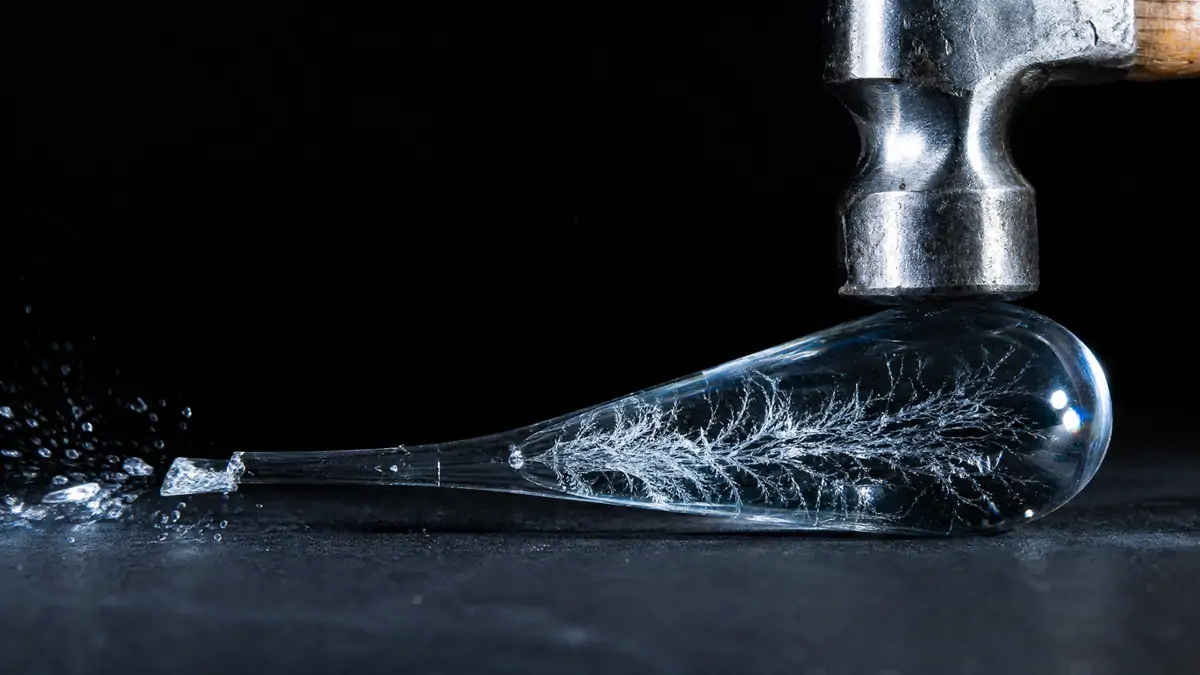
At first glance, a Prince Rupert’s Drop looks like an unusual piece of glass shaped like a tiny tadpole. But try hitting the rounded head and you may be surprised by what happens: it can withstand an impressive amount of force. Touch the thin tail in the wrong way, however, and the entire drop can suddenly break apart.
So what makes Prince Rupert’s Drops behave in such a strange way?
🔥 It All Starts With Hot Glass and Cold Water
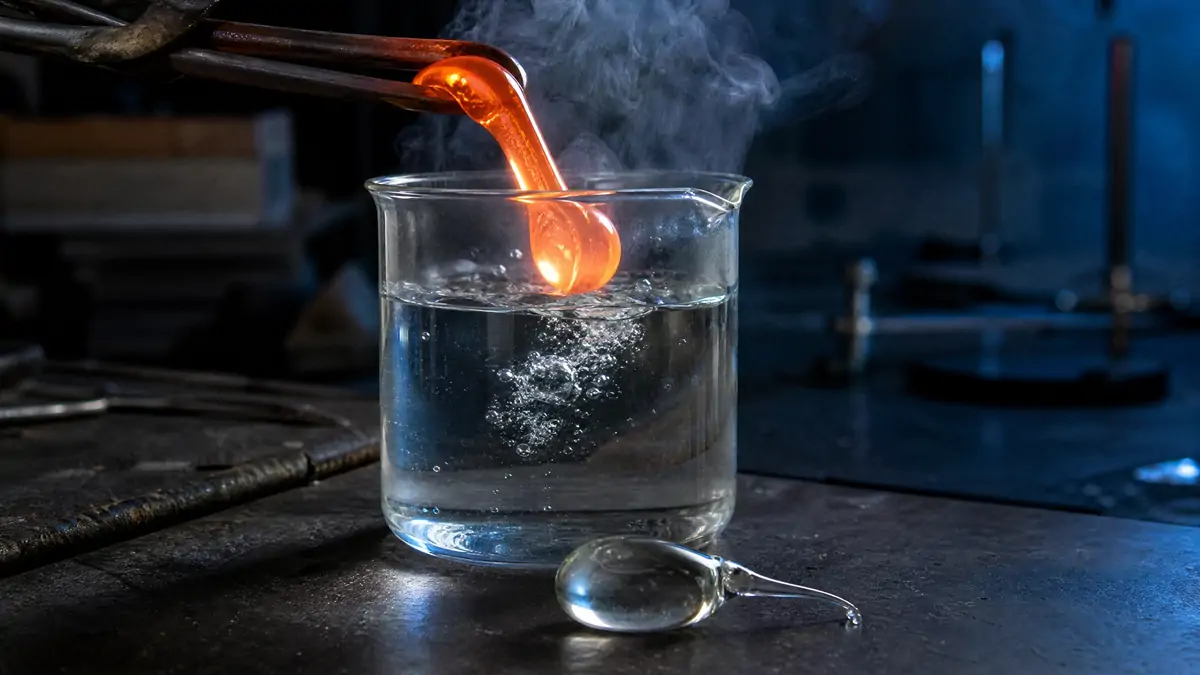
The unusual strength comes from the way the drop is made. Molten glass is formed into a small drop and quickly cooled in cold water. The outside of the glass cools and hardens much faster than the inside.
As the remaining hot glass inside cools down, it contracts. But the already-solid outer layer prevents it from contracting freely. This leaves the drop with a complicated pattern of internal stress: the outer part is under strong compression, while the interior is under tension.
That stress pattern is the key to understanding Prince Rupert’s Drops.
🛡️ Why Is the Head So Strong?
Glass normally has one major weakness: cracks can grow easily from tiny scratches or flaws on its surface. The compressed outer layer of a Prince Rupert’s Drop makes that much harder.
When an external force hits the rounded head, the compressive stress near the surface helps prevent cracks from opening and spreading. This is why the head can withstand forces far beyond what you might expect from an ordinary piece of glass.
In controlled experiments, the head of Prince Rupert’s Drops has been shown to withstand loads of more than 10 kN under specific testing conditions.
💥 Then Why Does the Tail Break So Easily?
This is where things get interesting.
The thin tail has a very different stress state from the head. Although part of its outer region is compressed, the inside contains tensile stress. Once a crack reaches this vulnerable region, the stored elastic energy can drive the crack rapidly through the drop.
Breaking the tail therefore doesn’t simply produce a small crack. It can trigger a self-sustaining fracture process that travels through the drop at extremely high speed.
This is why Prince Rupert’s Drops can go from apparently indestructible to completely shattered in a fraction of a second.
⚖️ Strength and Fragility in One Object
The fascinating part of Prince Rupert’s Drops is that their strength and weakness come from the same thing: residual stress.
The compressed outer layer protects the head from crack growth, while the tensile stress trapped inside provides energy that can be released when the tail is damaged. Rather than being simply “strong glass,” a Prince Rupert’s Drop is a carefully balanced structure of opposing stresses.
Recent research is also looking beyond thermal stress alone. Differences in the chemical composition between the outer shell and interior of the drop may also contribute to its unusual stress state.
🔬 A Simple Glass Drop With a Remarkable Story
What makes Prince Rupert’s Drops so fascinating is their simplicity. They are made from ordinary glass, yet the way that glass is cooled creates a structure capable of resisting enormous loads while remaining extremely sensitive to damage at the tail.
It is a great example of how the history of a material—how it was heated, cooled, and stressed—can completely change the way it behaves.
That strange combination of strength, instability, and explosive fracture is exactly why Prince Rupert’s Drops have fascinated scientists for centuries and continue to be studied today.