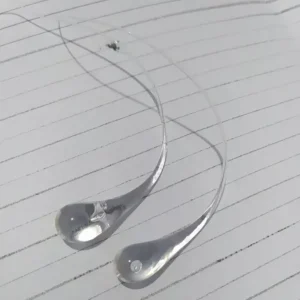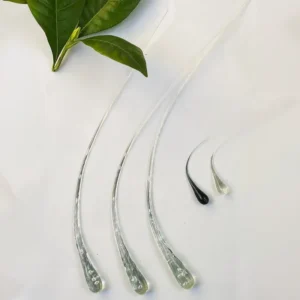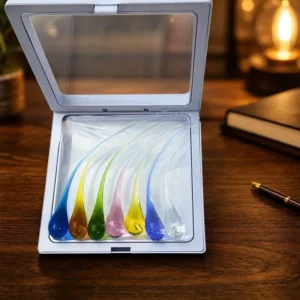
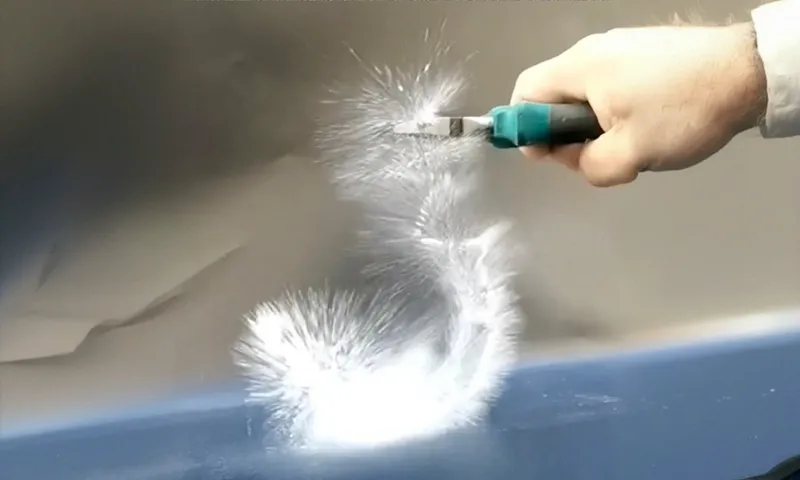
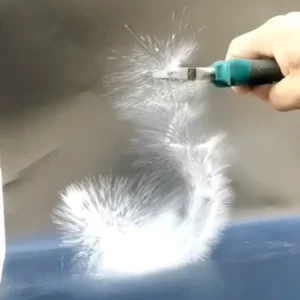
A Prince Rupert’s Drop looks like a simple piece of glass, but it behaves very differently from ordinary glass. The large rounded head can withstand surprisingly strong impacts, while the thin tail seems delicate and easy to break. The strange part happens when that tail is damaged or snapped: the entire drop can suddenly break apart in a fast, explosive-looking reaction.
So, why does this happen?
How a Prince Rupert’s Drop Is Made
A Prince Rupert’s Drop is created by dropping molten glass into cold water. The outside of the glass cools and hardens almost immediately, while the inside remains hot for a little longer.
As the interior eventually cools and contracts, it pulls against the already hardened outer layer. This creates a special pattern of internal stress throughout the glass.
The rounded head ends up with strong compressive stress near its surface. Compression makes it difficult for cracks to open, which helps explain why the head of a Prince Rupert’s Drop can survive impacts that would normally break ordinary glass.
But there is a trade-off. Deep inside the drop, the glass contains strong tensile stress. This stored energy is one of the main reasons the drop can fail so dramatically.
What Happens When the Tail Breaks?
The thin tail is directly connected to the stressed glass inside the head. When the tail is broken, a crack can enter the body of the drop.
Normally, a small crack might stop after traveling a short distance. In a Prince Rupert’s Drop, however, the internal stresses can drive the crack forward extremely quickly.
Once the crack reaches the highly stressed interior, the stored elastic energy is suddenly released. The crack can travel through the glass at very high speed, causing the drop to fragment into many tiny pieces.
This is why a Prince Rupert’s Drop appears to “explode” when its tail breaks. There is no chemical explosion involved. The dramatic effect comes from the rapid release of mechanical energy that was stored inside the glass during cooling.
Why Is the Head So Strong?
The unusual strength of a Prince Rupert’s Drop comes from its surface compression. To start a crack, the glass surface must first overcome this compressive stress.
This makes the rounded head surprisingly resistant to blows and pressure. However, the same internal stress that gives the head its strength also makes the drop extremely unstable if the protected stress structure is disturbed.
It is a fascinating example of how strength and fragility can exist in the same object.
A Small Tail With a Big Effect
The tail may look like the least important part of a Prince Rupert’s Drop, but it is actually critical to the drop’s stability. Breaking it provides a path for a crack to enter the stressed interior.
That is why handling these glass drops requires care. A drop may survive a direct strike on its head yet completely disintegrate when its tail is damaged.
The Prince Rupert’s Drop is a simple-looking glass object with a surprisingly complex structure. Its explosive breakup demonstrates the power of internal stress and shows how the way glass is cooled can dramatically change its behavior.
- Price range: $29.99 through $349.99 Select options This product has multiple variants. The options may be chosen on the product page
- Original price was: $59.98.$49.98Current price is: $49.98. Select options This product has multiple variants. The options may be chosen on the product page